Building an ADU in Long Beach: What It Costs, What It Pays Back
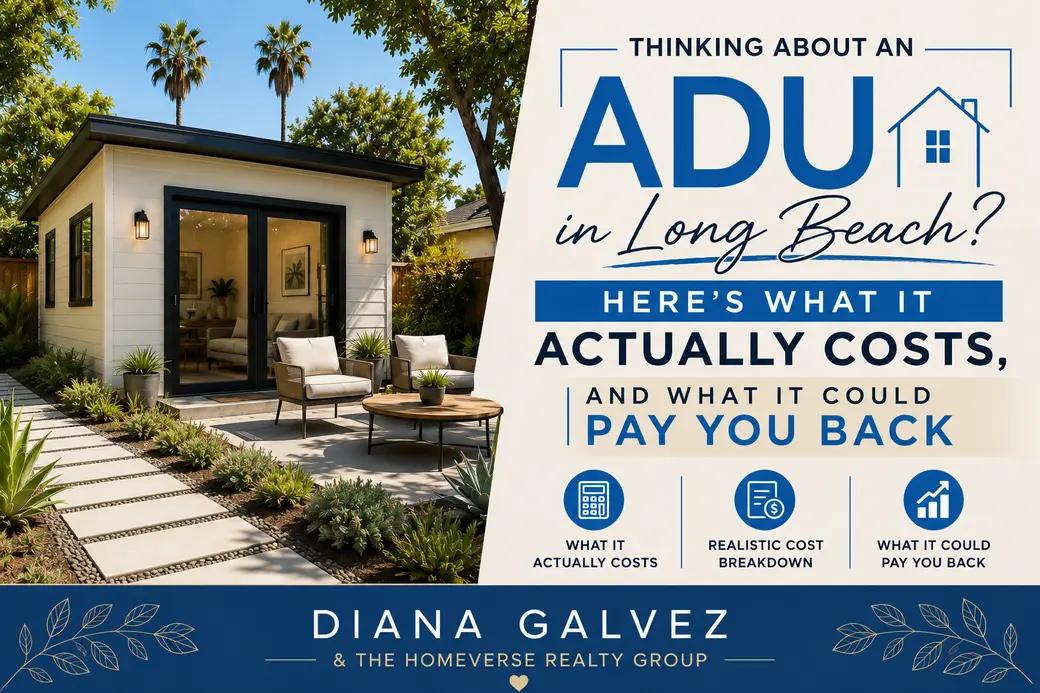
An ADU is one of the few home improvements that can pay for itself twice, once in monthly rental income, and again in resale value. If you own a home in Long Beach and have been wondering whether it's worth the investment, the honest answer is that it depends on the numbers, and the numbers are more favorable here than a lot of homeowners assume.
I'm Diana Galvez, a REALTOR® with HomeSmart Realty Group's Homeverse Team, and ADUs have become one of the most common questions I get from Long Beach homeowners looking to build wealth from a property they already own. Here's what the process actually looks like, and what it can realistically pay you back.
Long Beach Doesn't Have Its Own ADU Ordinance, and That's a Good Thing
Long Beach hasn't adopted a separate local ADU ordinance, which means applications are reviewed directly under California's state ADU law rather than a city-specific set of extra hurdles. That works in a homeowner's favor: state law requires ADU permits to go through ministerial review, meaning no discretionary approval process and no public hearing. If the city doesn't respond to a complete application within 60 days, it's deemed approved automatically.
That's a meaningfully simpler path than what homeowners in a lot of California cities are navigating right now, and it's worth knowing upfront if the word "permitting" is what's been holding you back.
The Size, Setback, and Occupancy Rules You Need to Know
A detached ADU in Long Beach can be built up to 1,200 square feet, and the city requires roughly a 4-foot rear setback for detached units, which is a low bar compared to standard residential setback requirements. There's also no owner-occupancy requirement, meaning you're not required to live in the main house to rent out the ADU, which keeps the door open for a pure rental income strategy if that's the goal.
The city has also set a public goal of permitting 400 to 500 new ADUs a year as part of a broader plan to add over 26,500 residential units by 2029, and periodically offers fee waivers or financial assistance for ADUs built to be rented at affordable rates. It's worth asking about current incentive programs before you finalize plans, since these do shift over time.
What It Actually Costs to Build One
Permit costs for a Long Beach ADU typically run $3,000 to $10,000. Construction costs are the bigger number: a custom, site-built ADU commonly runs $120,000 to $280,000, and it's not unusual for fully custom builds to land above $250,000 once site work, utilities, and finishes are factored in. Prefab ADU options can offer more predictable, all-in pricing, often landing around $298,800 depending on size and finish level, which some homeowners prefer specifically for the cost certainty.
Those are real numbers, and they're the reason the next section matters as much as it does.
What It Can Pay You Back
On the rental side, one-bedroom ADUs in Long Beach are generally renting in the $1,800 to $2,400 a month range, with two-bedroom units often higher, depending on location and finish quality. At the upper end of that range, a well-located ADU can generate close to $30,000 a year in rental income, which starts to meaningfully offset the construction cost within a handful of years, before factoring in any appreciation.
On the resale side, an ADU typically adds significant value to a property, and in many cases the equity increase from having a permitted, income-producing unit on the lot covers the build cost entirely, sometimes with room to spare. That combination, ongoing rental income plus a resale bump, is what makes an ADU function less like a renovation and more like an investment property you happen to build in your own backyard.
Is an ADU Worth It for Your Long Beach Property
The math works best on lots with room to build without major site complications, and it works best when a homeowner has a clear plan for the unit, whether that's a long-term rental, a space for family, or a short-term stay. It's not the right move for every property, but for the right lot, it's one of the more direct ways to turn existing equity into monthly cash flow.
If you want to talk through whether your property is a good candidate, or you want a referral to contractors and designers who know the Long Beach permitting process well, I'm happy to help you think it through.
You can reach me at (323) 807-4184 or casasbydianag@gmail.com. Let's see what your lot could support.
Diana Galvez, REALTOR®
Homeverse Team, HomeSmart Realty Group | DRE #02040313
Serving Long Beach, and the greater Los Angeles & Orange County area
Categories
- All Blogs (30)
- ADUs (1)
- Alamitos Beach (1)
- Bellflower (1)
- Belmont Heights (1)
- Belmont Shore (1)
- Bixby Knolls (2)
- Bluff Park (1)
- California Heights (1)
- Downey (1)
- Downtown Long Beach (1)
- Eastside (1)
- El Dorado Park Estates (1)
- Estate Planning (1)
- Financing & Lending (1)
- First-Time Buyers (1)
- Investment Properties (1)
- Los Altos Long Beach (1)
- Los Cerritos (1)
- Luxury Homes (1)
- Market Updates (2)
- Naples (1)
- New Construction (1)
- North Long Beach (1)
- Probate & Estate Sales (1)
- Retirement (1)
- Rose Park (1)
- Seller Tips (1)
- Wrigley Long Beach (1)
Recent Posts